Meetings and participation
Enter discussions, build points and contribute without overexplaining.
Explore → Book Diagnosis
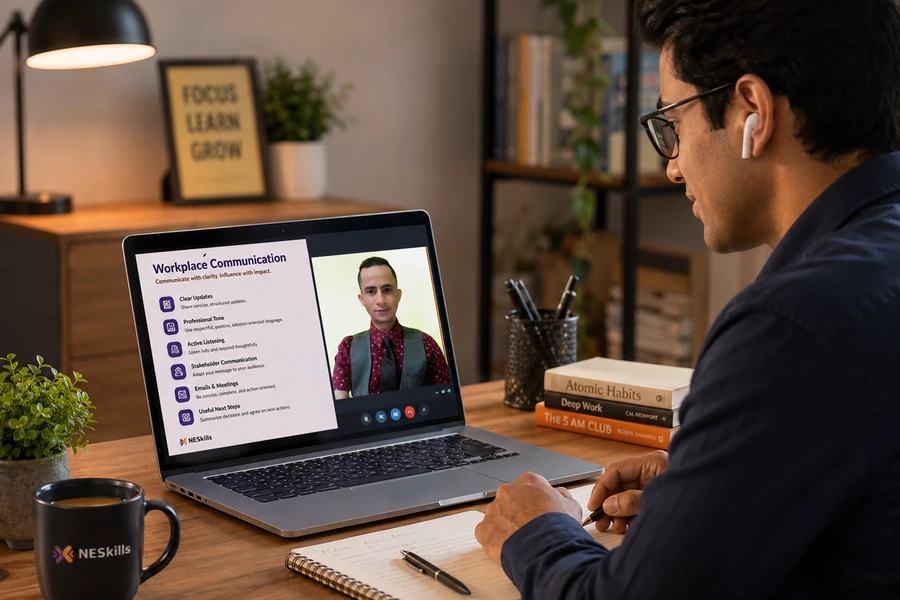
Live online workplace communication coaching
Improve meetings, updates, feedback and difficult conversations so your communication creates clarity, decisions and action—not more confusion.
No diagnosis fee. I message you on WhatsApp within 24 hours to confirm your 60‑minute diagnosis. Course fees are discussed only after it.
Communication that supports the work
Workplace communication changes with the audience, risk, relationship and decision required. Learners practice how to choose the point, level of detail, tone and next action for the situation.
Enter discussions, build points and contribute without overexplaining.
Explore →Present progress, risks and next steps in a concise structure.
Explore →Give and receive feedback without vagueness, defensiveness or personal attack.
Explore →Raise concerns, boundaries and disagreement with control and professionalism.
Explore →Adapt detail and tone for managers, colleagues, clients and teams.
Explore →Write messages that are easy to understand, act on and respond to.
Explore →Professional judgment under pressure
I coach the decision behind the communication: what must be said, what can be omitted, how direct the message should be and what the listener needs to do next.
Identify the audience, purpose, risk and decision required.
Decide whether to inform, clarify, question, persuade or set a boundary.
Practice the message, observe the response and refine the pattern.
Choose the delivery format
Each format trains the same skill through a different level of personalization, organizational support.
Deeper personalization around one learner, one goal and specific situations.
Explore format →Live online leadership coachingHigh-consequence communication for professionals, managers and leaders.
Explore format →Hybrid institutional deliveryCustom online, onsite or blended training for colleges, institutions and teams.
Explore format →Nationwide online accessJoin live founder-led coaching from Shillong from anywhere in India.
Explore format →The Five-Step Coaching Method applied here
The specialization changes the practice task, but the same five-stage coaching method keeps the learning journey clear and connected.
See the complete NESkills coaching system →Read the audience, relationship, purpose, consequence and current breakdown. Pinpoint where the message, listening or judgment loses clarity for this audience.
Learn a structure for the central message, supporting detail and next step.
Rehearse meetings, updates, feedback and difficult conversations with live correction.
Identify what is not working, make targeted corrections and repeat the response.
Use the stronger response independently in a real workplace situation.
Questions before you begin
It can cover meetings, status updates, presentations, feedback, disagreement, client conversations, professional email and difficult workplace discussions.
Yes. The work can be adapted for managers, team leads and professionals who need clearer delegation, feedback, stakeholder alignment and decision communication.
Yes. I am based in Shillong, Meghalaya, and offer live online workplace communication coaching across India. Suitable international online coaching depends on the role, goal and time zone.
Yes. Written communication can be reviewed alongside live speaking so the message remains concise, professional and action-oriented.
Not exactly. Language may be corrected, but the main focus is judgment, structure, tone and communication that helps work move.
Book a diagnosis to identify whether the breakdown is structure, tone, confidence, listening or pressure control.